
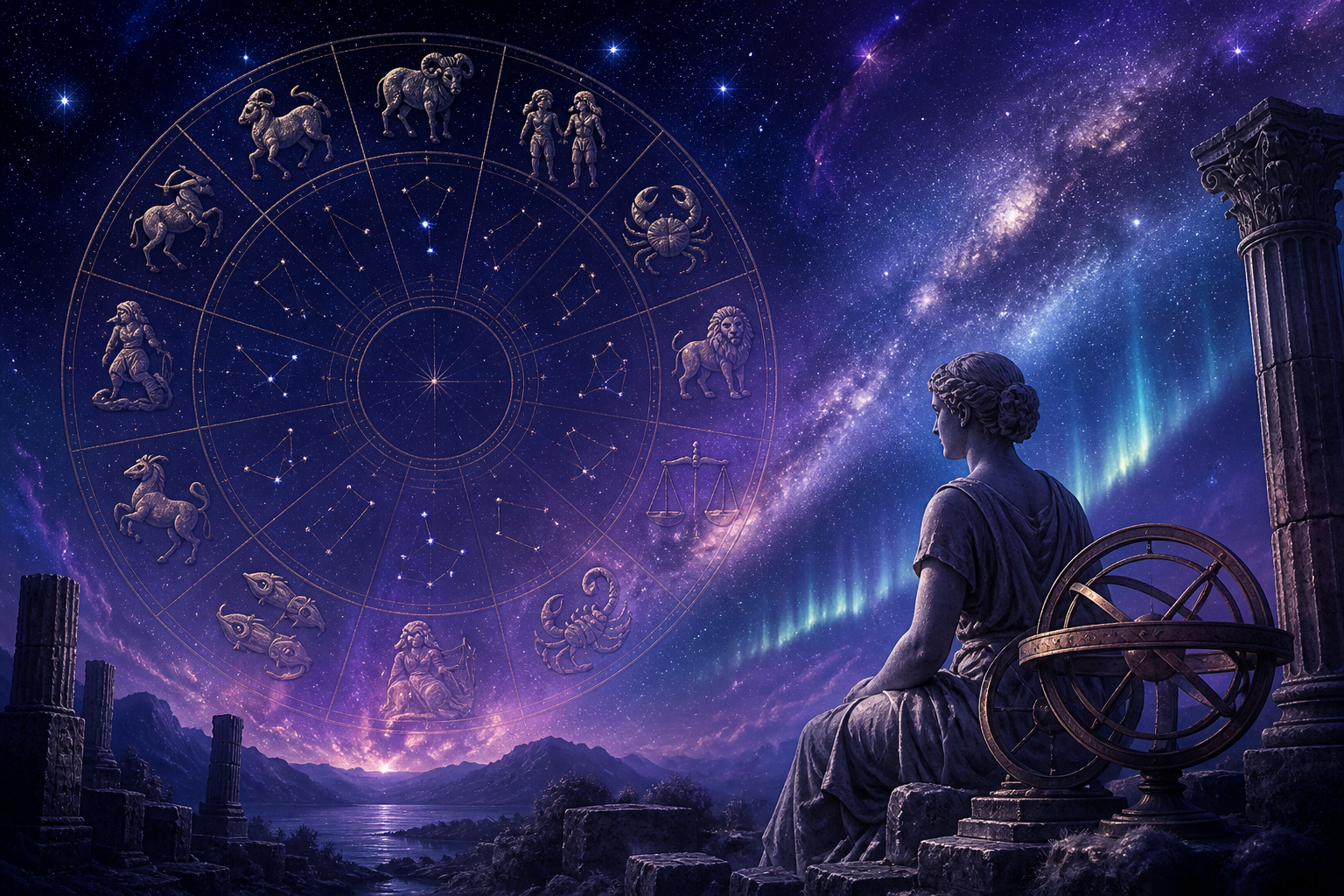
The zodiac is commonly presented as a circle divided into twelve signs. For beginners, the number can feel arbitrary and the symbols can seem like a list to memorize. A more useful approach is to see the zodiac as a sequence of recurring themes: beginning, stabilizing, communicating, protecting, expressing, refining, relating, intensifying, exploring, building, innovating, and dissolving.
The zodiac’s symbols developed through long traditions of observing the sky, measuring cycles, and linking seasonal patterns with mythic imagery. Different astrological systems use the zodiac in different ways, so terms and calculations can vary. The basic twelve-sign structure, however, provides a familiar language for discussing patterns across a chart.
Learn the signs as a sequence
Aries begins the cycle with initiative and emergence. Taurus follows with consolidation, resources, and steadiness. Gemini introduces exchange, curiosity, and movement between ideas. Cancer turns toward belonging, memory, and protection.
Leo develops self-expression, creativity, and visibility. Virgo refines through analysis, craft, and useful service. Libra brings attention to partnership, proportion, and negotiation. Scorpio deepens the cycle through intensity, trust, and transformation.
Sagittarius expands through travel, study, belief, and the search for meaning. Capricorn gives ambition a structure through responsibility, time, and achievement. Aquarius considers communities, systems, and new possibilities. Pisces completes the cycle through imagination, compassion, and porous boundaries.
This sequence is easier to remember than isolated keywords because each sign responds to the one before it. After expression comes refinement; after partnership comes deeper trust; after expansion comes structure. The signs can be studied as a conversation rather than twelve unrelated descriptions.
Add the four elements
The elements provide another layer. Fire signs—Aries, Leo, and Sagittarius—are associated with action, enthusiasm, and inspiration. Earth signs—Taurus, Virgo, and Capricorn—relate to material reality, consistency, and practical results. Air signs—Gemini, Libra, and Aquarius—emphasize thought, language, and social perspective. Water signs—Cancer, Scorpio, and Pisces—connect with feeling, memory, intuition, and imagination.
Notice that the signs in each element are not identical. Aries, Leo, and Sagittarius are all fire, but they express fire differently: beginning, radiating, and exploring. The element gives a family resemblance, while the individual sign adds a specific role in the zodiac sequence.
Then add the modes
The modes, also called modalities, describe how a sign handles change. Cardinal signs—Aries, Cancer, Libra, and Capricorn—initiate. Fixed signs—Taurus, Leo, Scorpio, and Aquarius—sustain and develop. Mutable signs—Gemini, Virgo, Sagittarius, and Pisces—adapt, translate, and prepare for transition.
Combining element and mode creates a compact study method. Aries is cardinal fire: it initiates through action. Taurus is fixed earth: it stabilizes through consistency. Gemini is mutable air: it adapts through information. Cancer is cardinal water: it initiates care and protection. Continue this pattern for the remaining signs, and their differences become easier to recall.
Use symbols without taking them literally
A ram, bull, twins, crab, lion, maiden, scales, scorpion, archer, sea-goat, water-bearer, and fish are symbolic images, not instructions about how every person behaves. The imagery can suggest a theme, but it should not become a stereotype. A Libra symbol does not mean every Libra avoids decisions, and a Scorpio symbol does not mean every Scorpio is secretive.
When reading a horoscope, ask which area of life the sign is describing and which planet or house is involved. A sign’s meaning changes with context. An internal beginner’s horoscope guide can help explain how broad sign symbolism becomes more specific when placed in a chart.
A five-step learning exercise
Choose one sign each day. Write its element, mode, sequence position, and three useful keywords. Then write one strength and one potential excess. For example, Sagittarius can be associated with mutable fire, expansion, curiosity, and meaning; its excess might be overpromising or overlooking details.
Finally, find the sign in your own birth chart. Notice whether it contains a planet, begins a house, or appears in a personal placement. Keep your interpretation tentative and compare it with lived experience. Learning astrology works best as an ongoing practice of observation.
The twelve signs become much more memorable when they are understood as a structured cycle. Their history, symbols, elements, and modes provide several entry points, allowing beginners to build knowledge gradually while leaving room for nuance.